

Hospitality at the luxury tier is judged in the first ten minutes after a guest closes the door. Not by a welcome tray competing for attention. By whether the room feels inevitable: the bed invites sleep, the light can go fully dark, the house noise softens, and a suitcase has somewhere to live that is not the upholstery.
This article contains affiliate links. As an Amazon Associate I earn from qualifying purchases.
That is the brief for the quiet guest suite edit — a restrained reset for secondary suites in homes above $700k. It borrows the grammar of a great hotel without copying the brand cues that photograph as “staged for company.” The goal is composure. Guests should feel considered. They should not feel managed.
Fall and early winter raise the stakes. More overnight visitors, longer stays, and evenings that lean on interiors rather than terraces — the same seasonal turn already shaping colour and outdoor rooms on Luxury Hôm in The New Fall Palette: Rich, Restorative Colors for the Luxury Home and Beyond the Patio: Designing an Outdoor Living Space for the Fall Season. A guest suite that only works in daylight is half-finished.
Edit first: what to remove before you add
Start with subtraction, the same discipline Luxury Hôm applies to listing presentation in Seller Staging That Photographs Like Editorial (Without Looking Staged). Clear surfaces that have become storage. Remove personal photography and identifying detail. Thin books and objects until the room can breathe. Retire anything that says “we only use this room when people visit” — matching amenity baskets, excessive pillows, and decorative trays that leave no place to set a glass of water.
Stop short of sterilizing. One strong vignette — a lamp, a chair that actually reads, a quiet vessel — beats five weak ones. Guests notice when a room was emptied for them; they also notice when it was over-dressed for Instagram.
Priority zones: the bed wall, the blackout line at the window, the path from door to bath, and a luggage landing that keeps cases off the bed and chairs. Everything else is secondary.
Sleep architecture: sheets, weight, and temperature calm
The bed is the product. Luxury guests forgive a slightly smaller closet. They do not forgive a noisy, overheated, or slippery sleep.
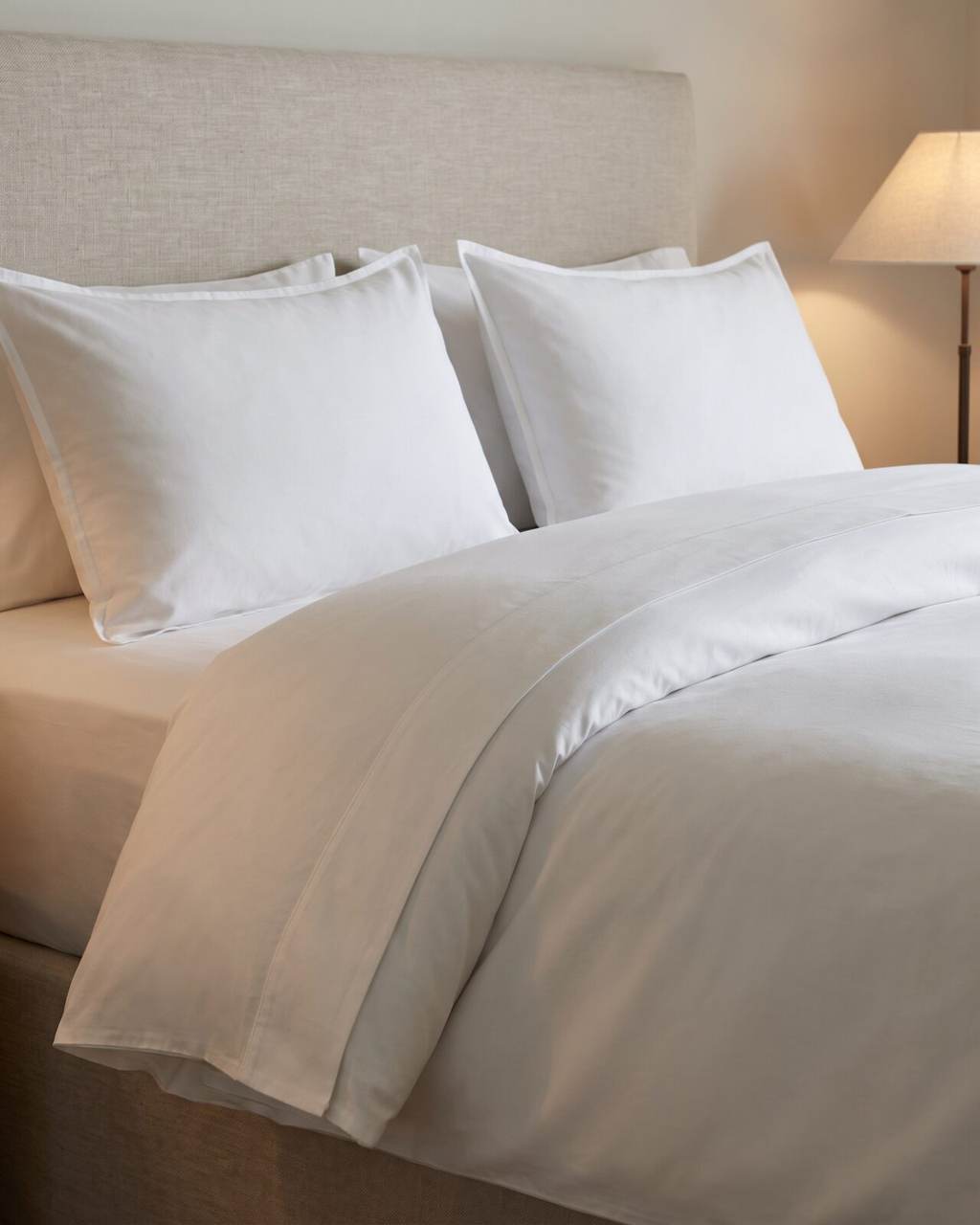
Percale and breathability. A quality percale sheet set — crisp, matte, cool to the touch — reads as quiet luxury more reliably than glossy, over-soft fabrics that pill after a season of laundry. Fit matters as much as fiber: deep pockets for hotel-height mattresses, and a flat sheet and cases that match the story.
Duvet discipline. A hotel-weight duvet insert in the correct size (king when the bed is king) gives the room a finished silhouette and lets you change the cover seasonally without rebuilding the bed. Avoid the stacked-quilt look that reads as retail display. One excellent duvet, properly sized, outperforms three competing layers.
Temperature and air. Confirm the suite can hold a sleep-friendly setpoint without blasting. If the room sits over a garage or beside mechanicals, solve that before adding another throw. Clean air belongs in the same conversation as recovery suites — see Private Recovery Circuit: What Buyers Tour for in Sauna, Plunge, and Rest Rooms — even when the guest room is not a spa.
Darkness, sound, and the private-club night
Evening rooms elsewhere in the house earn their mood through layered light — the same lamp-and-shadow discipline in The New Fall Palette: Rich, Restorative Colors for the Luxury Home. Guest suites earn theirs through control.
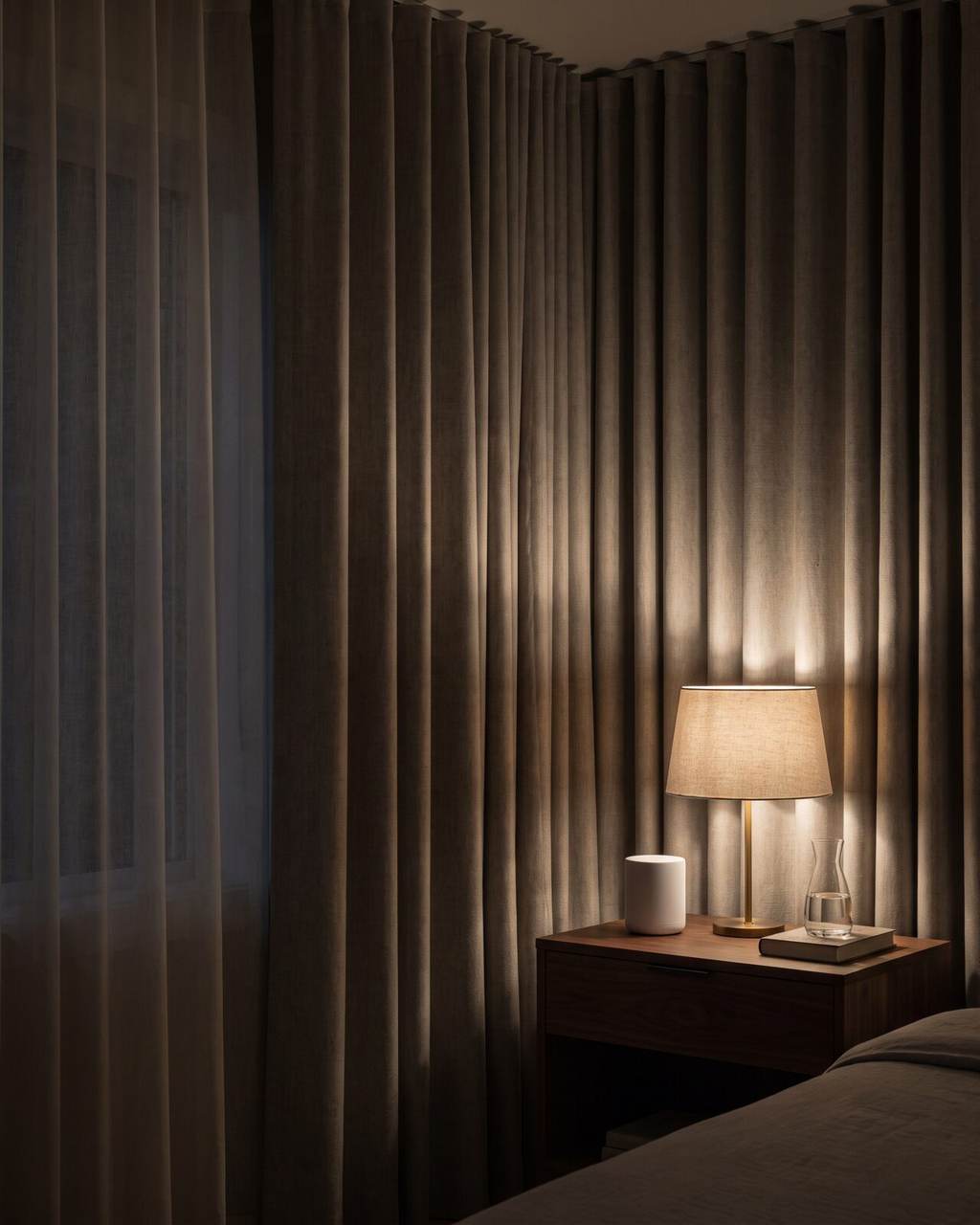
Blackout that actually blacks out. Curtains or shades must meet the frame and kill street glow, not merely decorate it. Lined panels in a calm textile often outperform novelty blackout kits that look temporary. If the architecture wants sheers for daytime softness, pair them with a true blackout layer — do not ask guests to choose between beauty and sleep.
Acoustic composure. A white noise machine is not an apology; it is hospitality infrastructure in houses near roads, kitchens, or entertaining floors. Place it where it masks without dominating. Soft textiles, a solid door seal, and quiet mechanicals do the rest. If the suite shares a wall with a primary living space, treat sound as a design problem, not a guest personality problem.
Lamps over overheads. For evening arrival, a pair of shaded lamps beats a bright ceiling. Guests should be able to settle without hunting for a single switch that floods the room.
Luggage ease and the dignity of arrival
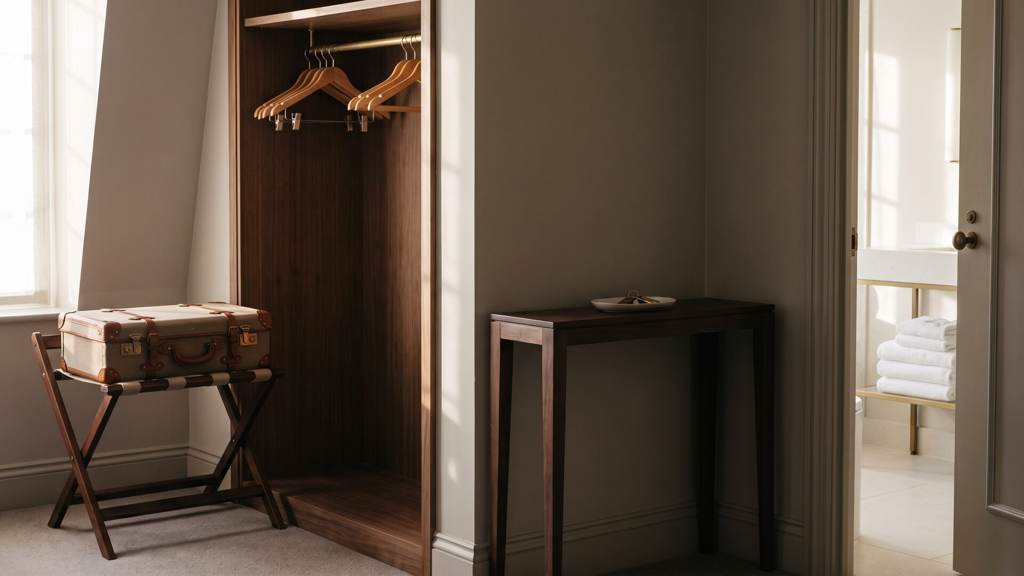
Hotel luggage racks exist because suitcases on beds destroy both textiles and first impressions. A wood hotel-style rack — light, foldable, honest — is one of the smallest upgrades with the largest hospitality return. Give it a clear wall or closet bay. Add a few empty hangers, a clear surface for keys and devices, and a bath that already holds fresh towels before anyone asks.
Multigenerational and long-stay guests raise the bar further. Soft separation, daylight, and a room that can host a week without looking improvised sit in the same composure conversation as winter readiness in Pre-Winter Systems Check for Luxury Homes — climate, air, and quiet systems that keep a secondary suite livable when stays stretch. Flexibility here is not a compromise look. It is architecture that can host independence side by side.
The quiet suite checklist
Before guests arrive
- Bed dressed in breathable sheets and one correct duvet.
- Blackout tested at night, not assumed at noon.
- White noise placed and volume preset.
- Luggage rack out; hangers free; surfaces clear.
- Bath stocked; trash empty; lighting scenes simple.
What not to do
- Do not over-pillow the bed into a retail pyramid.
- Do not leave personal products that imply the room is storage.
- Do not rely on a single overhead for evening arrival.
- Do not treat the suite as a furniture showroom that happens to have a bed.
If you are listing
Photograph the guest suite as a finished room, not a flex space apology. Buyers above $700k score overnight capacity and privacy as lifestyle fit — especially when fall inventory offers more comparative touring.
Hospitality that disappears into the house
The quiet guest suite edit is not a theme. It is a standard: sleep, darkness, sound, and arrival handled so well that guests stop noticing the equipment and start noticing the rest. That is the private-club test applied to a secondary room — atmosphere first, inventory second.
Luxury Lives Here includes the grace of hosting without performance. The suites that feel most expensive at midnight are often the ones that never had to announce how carefully they were prepared.